

How Much Did That Last Quality Issue Actually Cost You in Scrap?
Something goes wrong on the floor. A machine stutters. Output drops. A quality check fails. A batch just doesn't look right.
And the investigation kicks off. Someone calls a meeting. Someone pulls last week's report. Someone walks the floor. Someone rings the shift supervisor. Everyone's got a theory. Nobody's got the answer yet.
An hour goes by. Maybe two, maybe three. The root cause finally turns up, the fix gets applied, and the line starts moving again.
But the damage is already done. And a big chunk of that damage is sitting in your scrap bin rejected units, reworked batches, raw material that's gone to waste.
It's not just downtime that costs you. It's what got scrapped while you were figuring it out.
Here's the part most factories underestimate: every hour spent investigating is an hour the line might still be running quietly producing more of whatever's wrong. That's not just lost time on the clock. That's material consumed, packaging used, labour hours spent, all on output that ends up as scrap.
Most plant managers can tell you that they had a quality issue last month. Very few can tell you, down to the rupee, exactly how much material that one issue scrapped, what it cost, and whether it's happened before.
A real story: the four-hour hunt for a two-minute fix
Meet Harish. He runs a food processing unit, which includes packaged snacks, retail distribution, and operates on tight schedules with two shifts a day, six days a week. Thin margins, strict timelines, and consistency that matters more than almost anything else in the business.
One afternoon, his packaging line started turning out units with inconsistent seal quality. Not every unit just enough to trip a quality flag.
His team stopped the line and started checking. Was it the sealing machine's temperature? A change in the packaging film? Humidity on the floor that day? A calibration drift from the morning shift? An operator swap?
Six possible causes, easy. Checking each one by hand running tests, digging through logs, talking to operators which ate up nearly four hours.
The actual cause, once they found it, was almost embarrassingly small: a minor temperature drift in the sealing unit during the afternoon shift change. A two-minute fix.
But here's the number that actually mattered more than the four hours: that one affected run generated a real, measurable pile of scrapped packaging units that could not be sold, couldn't be reworked, had to be written off. Four hours of investigation. Two minutes to fix. And a scrap cost that nobody had an exact figure on until well after the fact.
Three weeks later, the exact same temperature drift happened again because the first investigation had found the symptom, not the underlying pattern, and nobody had flagged it as a repeat source of manufacturing scrap.
Why scrap is the number that actually tells the truth
Downtime you can see. The line stops, everyone notices, someone's already asking questions. Scrap is quieter. It piles up while the line is still running, one rejected unit at a time and almost nobody tallies it in real time.
That's the real gap. Without a precise, ongoing count of what's being scrapped and why, every factory ends up estimating: "roughly this much," "about that quantity," "somewhere in that range." Fine for a monthly report. Nowhere near precise enough to catch a repeat problem before it repeats a third time.
Where VISTAAR AI comes in
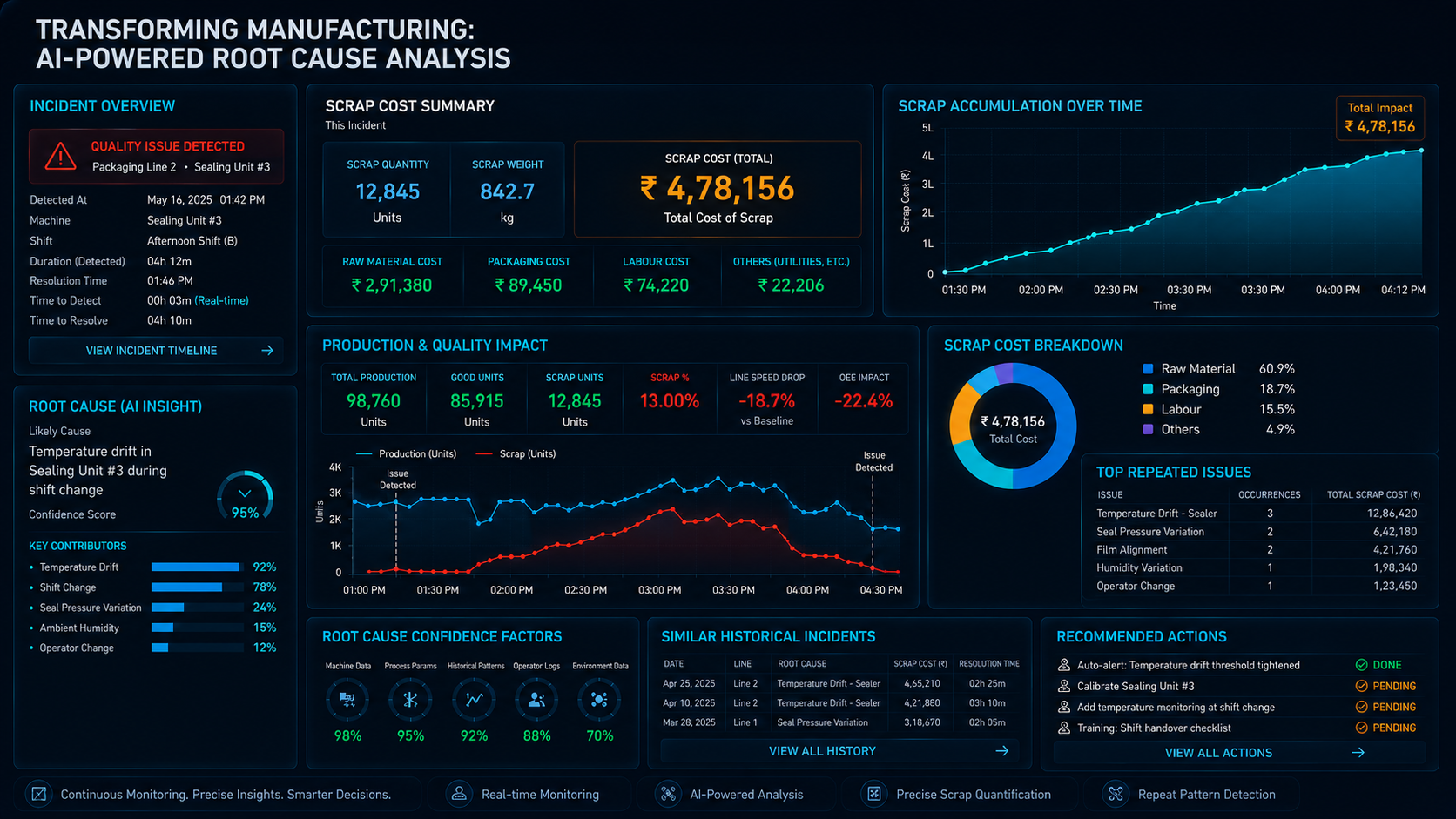
VISTAAR AI is built to close exactly that gap which includes continuous monitoring of your production data, so when something goes wrong, your team isn't starting the investigation from zero.
- Flags the event as it happens. The anomaly surfaces in real time, not hours later pieced together from separate logs and reports.
- Points to exactly where it happened. The specific machine, line, shift, or department involved.
- Quantifies the scrap, precisely. An exact figure for material, units, and rupee cost tied to that specific incident, not reconstructed from memory afterward.
- Surfaces the likely cause. Data-backed, to narrow the investigation instead of pretending to replace it.
- Flags repeat patterns. So something like Harish's temperature drift gets caught the second time it happens, not the third or fourth.
To be clear — this isn't about replacing your floor team's judgment. It's about making sure that when they do investigate, they're working from an exact number instead of a guess, and that every incident's scrap cost is counted accurately from day one, not reconstructed weeks later.
Why this actually matters more than it sounds like it should
"We scrapped some material" doesn't help anyone fix anything. A precise, per-incident scrap figure does three things a vague estimate never can:
- It tells you which problems are genuinely expensive versus which ones just feel disruptive in the moment.
- It catches repeat issues by matching today's scrap pattern against last month's, instead of relying on someone's memory.
- It gives you a real number to put in front of your team, your plant head, or your board not a shrug and an estimate.
Ask yourself this
How precisely can your factory answer this question right now: how much scrap did that last quality issue actually generate, and what did it cost you?
If the honest answer is "roughly" or "we'd have to go check" that's the gap worth closing first.