
Real-Time Factory Monitoring: Why the Problems You Can't See Are Costing You the Most
The most dangerous problems in your factory aren't the ones that trigger an alarm. They're the ones nobody notices until it's too late.
Right now, while you're reading this, there's a good chance a quiet, invisible issue is draining your production, your quality, or your margins somewhere on your floor. No dramatic breakdown. No warning light. Just a slow leak in your bottom line that nobody has reported yet.
For factory owners and plant managers, that's the real risk: not the problems you know about, but the ones still hiding in plain sight.
Why delayed detection is the hidden cost of manufacturing
When something goes wrong on the shop floor a machine running off spec, a quality drift, a process breakdown there's usually a chain of events before it reaches decision-makers.
A worker notices something unusual. They tell a supervisor. The supervisor investigates. It gets escalated. A report gets pulled. A meeting gets scheduled.
Somewhere in that chain, time passes. One hour. Two hours. Sometimes a full shift. Sometimes days.
And the problem doesn't wait for that chain to finish. It grows. Production slows. Teams scramble. Decisions get made in confusion. By the time the issue is finally visible to leadership, the damage is already done you're no longer preventing a loss, you're calculating one.
This is the core challenge that real-time factory monitoring solves: shrinking the gap between when a problem starts and when someone finds out.
A real-world example: How a small deviation became a costly mistake
Consider Priya, who runs a plastics and rubber components manufacturing unit producing automotive parts and industrial fittings under tight tolerances. Her facility runs three shifts, and consistency is non-negotiable.
During a night shift, a temperature deviation occurred in one of her injection moulding machines. It was subtle just enough to throw off dimensional accuracy, not enough to trigger an alarm. The operator sensed something felt slightly different but assumed it was normal variation.
The machine kept running. The shift continued.
By the time the end-of-shift quality check caught the problem, four hours of production had passed. Nearly 6,000 components had been manufactured most of them out of tolerance.
The result: rework costs, wasted material, a delayed dispatch to a key automotive client, and an uncomfortable call Priya had to make the next morning.
The deviation itself lasted four hours. The fix, once identified, took two minutes.
Nobody knew there was a problem. So nobody acted. Four hours of unnoticed drift became four hours of measurable loss.
It's Not the Problem That Hurts You — It's the Delay in Finding Out
Every factory deals with variation. Machines drift. Processes shift. That's the nature of manufacturing.
What separates a facility that absorbs these issues cheaply from one that takes heavy losses isn't the absence of problems it's the speed of detection and response.
- A deviation caught in the first minute costs almost nothing.
- The same deviation caught four hours later can cost lakhs.
- Left unnoticed for days, it can quietly cost crores.
In other words, your losses aren't just a function of what goes wrong. They're a function of how long it takes you to know.
How Real-Time Monitoring Changes the Equation
This is exactly the gap that solutions like VISTAAR AI are built to close.
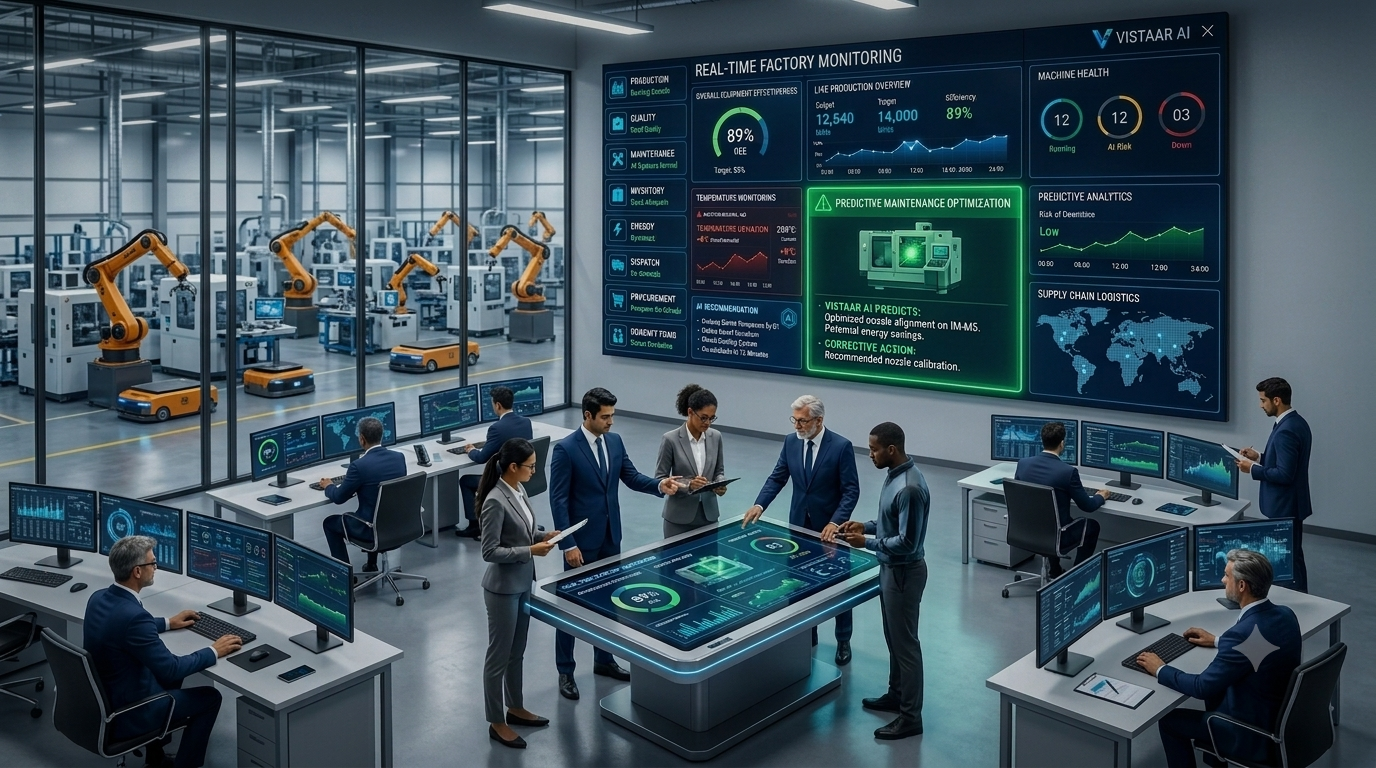
VISTAAR AI continuously monitors every machine, process, and department on your factory floor in real time. The moment a deviation occurs a temperature spike, a quality drift, a process running off spec it sends an instant alert.
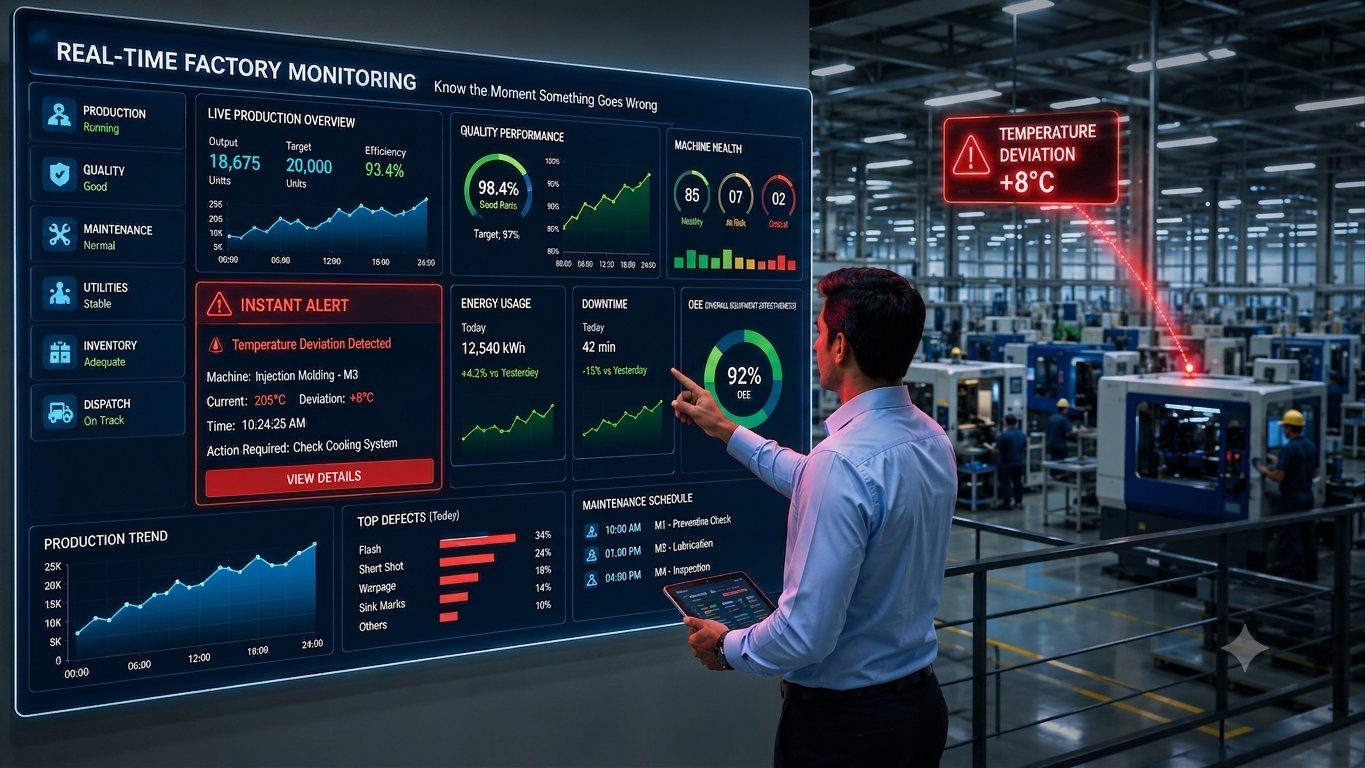
Not a vague notification. Not a report that lands in your inbox the next morning. A real-time alert that tells you:
- What happened
- Where it happened
- What action to take next
Instead of discovering an issue four hours (or four days) later, you know within seconds and you can act within seconds. The problem gets contained before it spreads to the next shift, affects the customer, or grows into a larger loss.
What Instant Visibility Looks Like in Practice
Had Priya's temperature deviation been caught in real time, it would have been a two-minute fix with zero lost production instead of four hours of rework, wasted material, and a delayed client delivery.
The difference wasn't her team's expertise or effort. It was simply knowing sooner.
That's the value real-time monitoring delivers across every shift, every department, every day: no late discoveries, no preventable damage, just the ability to catch and correct issues before they compound.
Calculate what unnoticed problems are really costing you
Ask yourself: how much is your operation losing every hour a problem goes unnoticed? Try estimating it.
- One hour of reduced production.
- One hour of quality drift.
- One hour of a process running off spec.
Multiply that by your number of shifts, lines, and working days in a month. For most manufacturers, the number is far higher than expected.
Now ask a second question: what would it mean if every one of those problems was caught in the first second instead?
The bottom line
In manufacturing, problems are inevitable drift, variation, and deviations will always happen. What determines whether they become minor blips or major losses is how quickly you find out and how fast you can act.
Real-time factory monitoring turns hours of blind exposure into seconds of visibility, giving plant leaders the chance to stop losses before they touch production, quality, or margins.
VISTAAR AI is built for exactly this: helping manufacturers know first, every time.