

Bridging the Productivity Gap: How Manufacturers Transform Idle Time Into Peak Output
Machines were ready. Raw material was available. So why were production targets being missed every single month?
For many plant managers, this creates a frustrating puzzle. The business has invested in advanced machinery, built solid production planning processes, and even implemented full ERP systems to keep operations organized. On paper, everything looks ready to perform.
Yet, month after month, output falls short.
When leadership looks at the floor, the equipment is functional, attendance is normal, and workers are present. The assumption is usually that machinery needs an upgrade or planning needs adjustment. But very often, the real bottleneck is completely invisible to standard reporting tools.
The Gap Between Attendance and Productivity
When production targets start slipping despite having healthy equipment and materials, the problem rarely lives on the mechanical side. It lives in the workforce execution layer.
Most plants track attendance through standard HR systems: workers clock in, get marked present, and fulfill their shift hours. But attendance and true productivity are two entirely different metrics.
When historical workforce records, shift reports, and machine utilization logs are analyzed together, a surprising operational reality frequently emerges:
- The Hidden Idle Hours: Operators can be fully present on the floor yet accumulate significant blocks of non-productive time across a single shift due to workflow gaps, bottlenecks, or unmonitored downtime.
- Shift-Wise Discrepancies: Night shifts often run at a noticeably lower efficiency rate than day shifts, quietly eating into monthly output targets without any single incident explaining the drop.
- The Overtime Trap: Overtime expenses climb sharply while output remains flat. Instead of fueling genuine production surges, overtime hours are frequently being used simply to compensate for productivity losses that occurred during regular working hours.
When a workforce is present on paper but under-engaged in practice, manufacturing capacity quietly erodes.
Restoring Visibility to the Factory Floor
Solving chronic production shortfalls requires looking beyond basic attendance tracking and gaining deep visibility into how time and labor are actually utilized on the shop floor.
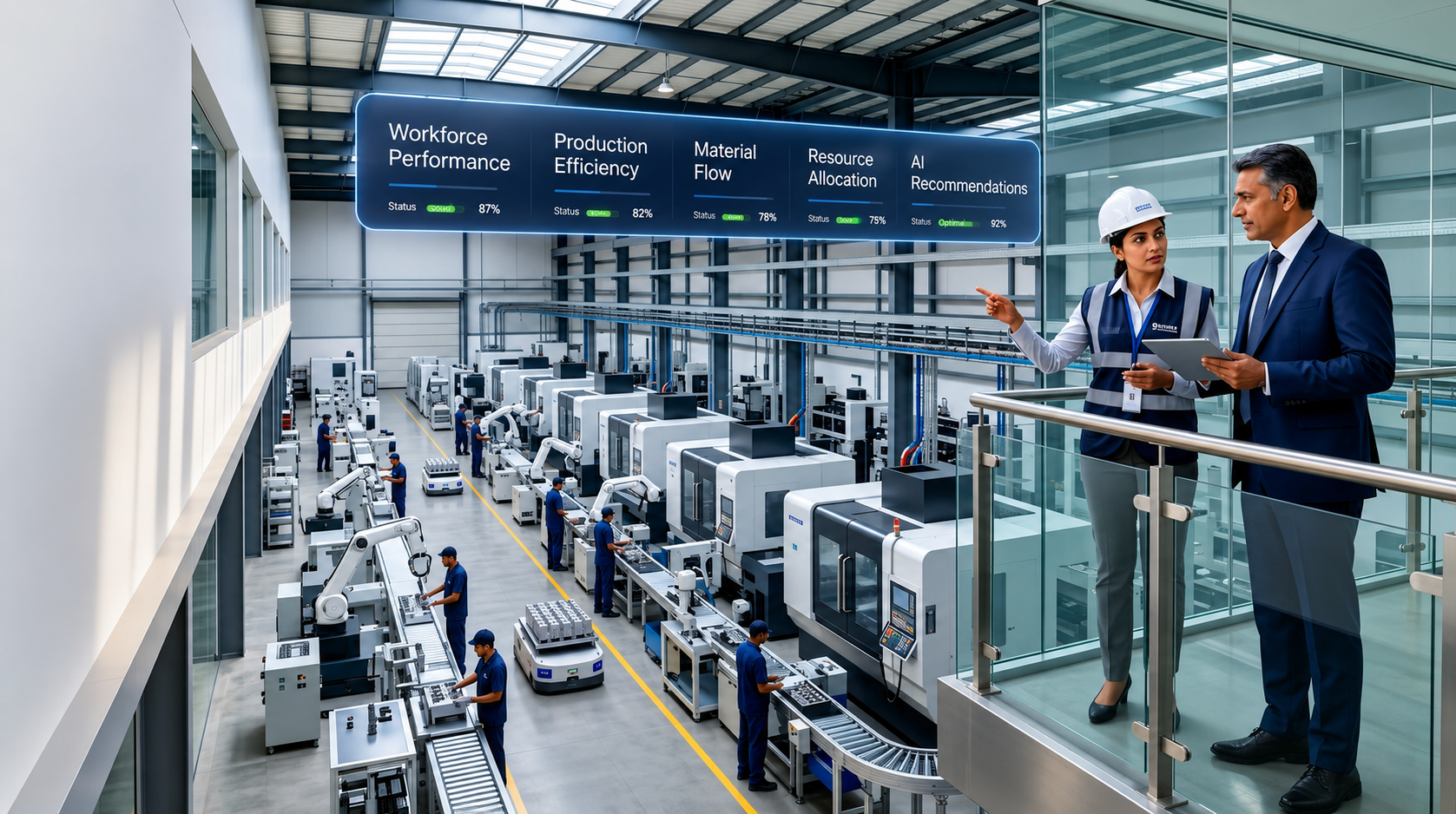
Modern manufacturers achieve this by integrating operational and workforce intelligence into a unified platform, introducing key capabilities such as:
- Real-Time Manpower Tracking: Monitoring productive versus non-productive time continuously, shift by shift, allowing supervisors to address workflow bottlenecks while the shift is still running.
- AI-Based Productivity Analytics: Automatically analyzing output per operator, per machine and per shift to give management an objective, data-backed view of where performance stands.
- Operator Efficiency Benchmarking: Measuring individual performance against defined standards to identify top performers, support underperforming stations and optimize shift scheduling.
Turn Workforce Gaps Into Predictable Output
Production problems are not always machine problems. When targets are consistently missed despite having the right physical resources, the hidden gap usually sits between an operator clocking in and actual productive output.
Reclaiming that lost capacity doesn't require purchasing new machinery or expanding headcount. It simply requires making workforce performance visible shift by shift, operator by operator so leadership can turn hidden idle time into measurable, predictable production.